Clear Dietetics
Nutrition for muscle-building, body composition and strength training
1:1 Nutrition Package - £195
Consultation + personalised plan & report - plus complimentary resources & 14-day email support
Support tailored to your goal
• build muscle
• reduce fat while maintaining muscle
• fuel strength training
How it works
• book online
• up to 60-minute telephone consultation
• personalised written report and plan
• complimentary resources + 14-day email support
Your dietitian
• Stephen
• HCPC-registered dietitian
• degree-qualified
• legally protected title
• several years’ experience
• NHS experience
• practical, evidence-based support
UK adults only. Eating disorders, severe gastrointestinal symptoms and urgent or complex medical concerns may require a different or specialist service.

PRIVACY POLICYLast updated: 14 October 2026Clear Dietetics is committed to handling your personal information lawfully, fairly, transparently and securely.WHO WE AREClear Dietetics is the trading name of Stephen Young, an HCPC-registered dietitian.For data-protection purposes, Stephen Young trading as Clear Dietetics is the controller of the personal information described in this policy.Business address:
[INSERT GEOGRAPHICAL BUSINESS ADDRESS]Email: [email protected]For privacy questions, data-rights requests and routine correspondence, please contact Clear Dietetics by email.WHO THIS POLICY APPLIES TOThis policy applies to people who:• visit or interact with the Clear Dietetics website;
• use a Clear Dietetics website tool or resource;
• book or receive a Clear Dietetics service;
• provide information through the booking process;
• communicate with Clear Dietetics by email, telephone, text message, booking platform or social media.WHAT INFORMATION WE COLLECTDepending on how you interact with Clear Dietetics, we may collect:• your name;
• your email address;
• your telephone number;
• booking and appointment information;
• payment and transaction information;
• information you choose to provide before your consultation;
• your goals;
• height and weight where provided;
• usual food and drink intake;
• training and activity information;
• health and medical information;
• information about medication and supplements;
• information about allergies or intolerances;
• relevant body measurements and body-composition information;
• optional photographs you choose to provide where relevant to body-composition assessment;
• information discussed during a dietetic consultation;
• consultation notes;
• personalised written reports and nutrition plans;
• follow-up emails and other service-related communications;
• information needed to manage cancellations, complaints, data-rights requests or legal matters;
• limited technical website and system information, such as IP address, browser or device information and security logs where collected by the relevant systems.Information requested through the booking process may be optional unless clearly stated otherwise.HEALTH INFORMATIONInformation concerning your health is special-category personal data and receives additional protection under data-protection law.We only collect or use health information where it is reasonably necessary for purposes including:• assessing whether Clear Dietetics is an appropriate service for you;
• providing safe and appropriate dietetic assessment and advice;
• assessing relevant body-composition information;
• preparing your personalised written report and plan;
• responding to appropriate follow-up questions;
• maintaining professional records;
• meeting professional, regulatory, insurance or legal responsibilities.Where relevant to a body-composition goal, you may voluntarily choose to send a recent body or upper-body photograph by text during your consultation.Providing a photograph is entirely optional and is not required to receive the service.A photograph may be used as supporting visual information when assessing your current body composition, including, where appropriate, a broad approximate visual estimate of body-fat range. It is not treated as a precise body-fat measurement and is considered alongside other relevant information.Health information is treated as confidential.It is not used for unrelated advertising or marketing.WHERE WE GET INFORMATION FROMWe normally receive information directly from you when you:• use the website;
• book an appointment;
• answer optional booking questions;
• speak with Clear Dietetics during a consultation;
• provide information by email, text message or another agreed communication method;
• use your complimentary 14-day follow-up email support;
• make a complaint or exercise a data-protection right.We may also receive limited information from:• booking providers;
• payment processors;
• another healthcare professional where you have requested or authorised this, or where receiving the information is otherwise lawful and appropriate;
• another person acting on your behalf with appropriate authority.If you communicate with Clear Dietetics through Instagram, Facebook or another external platform, that platform will also process information under its own privacy terms.Please do not post sensitive health information in public comments.HOW WE USE YOUR INFORMATIONWe may use personal information to:• assess whether the service is suitable for you;
• arrange and manage your booking;
• process payments, cancellations and refunds;
• prepare for your consultation;
• provide dietetic assessment and advice;
• assess relevant body measurements and body-composition information, including an optional photograph where provided;
• prepare and send your personalised written report and nutrition plan;
• provide complimentary access to Clear Dietetics resources;
• provide the complimentary 14-day follow-up email support;
• respond to service-related questions and updates;
• maintain appropriate clinical, professional and administrative records;
• manage cancellations and complaints;
• respond to data-rights requests;
• maintain the security and operation of our website, email and other systems;
• prevent or investigate misuse or fraud;
• comply with professional, regulatory, insurance, accounting, tax and legal requirements;
• establish, exercise or defend legal claims.PROVIDING YOUR INFORMATIONYou are not required to provide personal information merely to browse general website content.The Clear Dietetics protein calculator operates within your browser. Clear Dietetics does not receive or save the height, weight or goal information you enter into that calculator.Some information requested when booking is optional.Providing a body-composition photograph is also entirely optional and is not required to receive the service.However, certain information is necessary to:• make and manage a booking;
• process payment;
• contact you for your appointment;
• provide safe and appropriate personalised dietetic advice;
• prepare your personalised report and plan;
• provide follow-up support;
• meet professional and legal responsibilities.If information that is reasonably necessary is not provided, Clear Dietetics may be unable to provide all or part of the service safely or appropriately.LAWFUL BASES FOR PROCESSINGClear Dietetics relies on one or more lawful bases under Article 6 of the UK GDPR depending on why information is being processed.ContractWe may process information where this is necessary to:• take steps at your request before entering into a contract;
• arrange and manage your booking;
• provide the service you have booked;
• process payment, cancellation or refund;
• communicate with you about the booked service.Legitimate interestsWe may process information where reasonably necessary for legitimate interests including:• administering and operating Clear Dietetics;
• providing and managing complimentary aftercare;
• maintaining appropriate professional and administrative records;
• securing our website, email and other systems;
• responding to enquiries and complaints;
• preventing misuse or fraud;
• improving business processes and service delivery;
• establishing, exercising or defending legal claims.Where legitimate interests are relied upon, Clear Dietetics considers whether the processing is necessary and proportionate and whether your rights and interests outweigh those interests.Legal obligationWe may process information where necessary to comply with applicable legal or regulatory requirements, including data-protection, tax and accounting obligations.Vital interestsIn exceptional circumstances, personal information may be processed or shared where this is necessary to protect someone's life or physical safety and the relevant legal requirements are met.ConsentWe may rely on consent where this is specifically requested and appropriate, for example for optional marketing or a disclosure that is not covered by another lawful basis.Where processing is based on consent, you may withdraw that consent.Withdrawal does not affect processing that was lawful before consent was withdrawn.SPECIAL-CATEGORY HEALTH INFORMATIONWhere health information is processed for dietetic assessment, advice, treatment or related healthcare purposes, Clear Dietetics relies on:• Article 9(2)(h) UK GDPR; and
• Schedule 1, Part 1, paragraph 2 of the Data Protection Act 2018.This permits necessary processing for health or social-care purposes by, or under the responsibility of, a professional subject to confidentiality obligations.This may include relevant body-composition information and an optional client-supplied photograph where it is used as part of dietetic assessment.Where applicable, Clear Dietetics may also rely on:• Article 9(2)(c) UK GDPR where processing is necessary to protect vital interests and the relevant legal requirements are met; or
• Article 9(2)(f) UK GDPR where processing is necessary for the establishment, exercise or defence of legal claims.
WHO WE SHARE INFORMATION WITHPersonal information may be shared where reasonably necessary with service providers that support the operation and delivery of Clear Dietetics.These may include:• booking and appointment-management providers, such as Calendly;
• payment processors;
• email and productivity providers, such as Google;
• website and hosting providers, such as Carrd;
• technology service providers used to support preparation, administration and delivery of the service;
• professional advisers, accountants or insurers;
• healthcare professionals where you have authorised the disclosure or where sharing is otherwise lawful, necessary and appropriate;
• regulators, courts, law-enforcement bodies or public authorities where disclosure is required or permitted by law;
• organisations involved in protecting a person from a serious and immediate risk where disclosure is lawful and necessary.Only information reasonably necessary for the relevant purpose should be shared.Where another organisation processes information on behalf of Clear Dietetics, appropriate data-protection arrangements will be used where required.PAYMENT INFORMATIONPayments may be processed by a third-party payment provider.Clear Dietetics may receive information including:• whether payment was successful;
• the amount paid;
• transaction references;
• refund information.Clear Dietetics does not normally receive or retain your complete payment-card details.INTERNATIONAL PROCESSING AND TRANSFERSSome technology and service providers used by Clear Dietetics may store or process personal information outside the UK.Where this constitutes a restricted international transfer, Clear Dietetics will take reasonable steps to ensure that an appropriate transfer mechanism or safeguard is in place as required by UK data-protection law.Depending on the provider and destination, this may include:• UK adequacy regulations;
• an International Data Transfer Agreement;
• the UK Addendum to approved Standard Contractual Clauses; or
• another lawful transfer mechanism.Where required, relevant transfer risks and safeguards will also be considered.HOW WE STORE AND PROTECT INFORMATIONPersonal information may be stored or processed within:• the Clear Dietetics business email account;
• booking and appointment systems;
• payment systems;
• secure devices and accounts used to provide or administer the service;
• systems operated by service providers used by Clear Dietetics.The retained professional record may include:• relevant assessment and consultation information;
• your personalised written report and nutrition plan;
• relevant email correspondence;
• other information required to maintain an appropriate record of the care and advice provided.Clear Dietetics uses proportionate technical and organisational safeguards.These may include:• password-protected accounts and devices;
• multi-factor authentication where available;
• restricted access;
• current software and security updates;
• data minimisation;
• appropriate deletion or disposal processes;
• limiting the number of systems in which identifiable information is retained.Optional body-composition photographs sent by text are viewed only for the relevant consultation or assessment. Clear Dietetics does not intentionally download, copy into the clinical record, save separately or otherwise retain the photograph. After review, the photograph is deleted from the Clear Dietetics messaging thread. Where relevant, the professional record may instead contain a written summary of the assessment or conclusion drawn from the photograph.No internet, email or electronic system can be guaranteed to be completely secure.Please contact Clear Dietetics promptly if you believe information has been sent to the wrong person or that an account or communication may have been compromised.HOW LONG WE KEEP INFORMATIONClear Dietetics keeps personal information only for as long as reasonably necessary for the purposes for which it was collected and to meet professional, legal, regulatory, insurance and business requirements.Optional body-composition photographs are not intentionally retained as part of the clinical record and are not subject to the normal eight-year clinical-record retention period. They are deleted from the Clear Dietetics messaging thread after review. Any clinically relevant written interpretation recorded in the professional record is retained under the normal clinical-record retention period.Clinical and professional recordsClinical records, personalised reports and plans, and relevant clinical communications are normally retained for 8 years after the last clinical contact and are then reviewed.Information may be retained for longer where this is reasonably required, for example because of:• a complaint;
• a legal claim;
• an investigation;
• an insurance requirement;
• another professional or legal obligation.Booking, payment and administrative informationBooking, payment, refund, invoice and related administrative information may be retained for as long as reasonably necessary to meet accounting, tax, contractual and legal requirements.Website and system informationTechnical and security information is retained only for as long as reasonably necessary to operate, protect and troubleshoot the relevant systems.Clear Dietetics periodically reviews information held and deletes or anonymises information that is no longer reasonably required.MARKETINGClear Dietetics does not currently use client health information for marketing.Clear Dietetics does not currently operate a routine promotional email mailing list using client information obtained through dietetic consultations.Purely administrative or customer-service emails relating to matters such as:• your booking;
• your consultation;
• your personalised report and plan;
• your included 14-day email support;
• cancellations or refunds;
• other administrative matters relating to a service you have requestedare service-related communications where they contain no promotional material.If a communication promotes another Clear Dietetics service or encourages a new purchase or booking, direct-marketing rules may apply.If Clear Dietetics introduces electronic direct marketing in future, it will only be carried out where permitted by applicable data-protection law and the Privacy and Electronic Communications Regulations.COOKIES AND WEBSITE TECHNOLOGYThe Clear Dietetics website and its service providers may use essential cookies or similar technologies where necessary to:• operate the website;
• maintain security;
• provide requested functions;
• prevent misuse.Clear Dietetics does not currently configure non-essential analytics or advertising cookies on its website.If non-essential analytics, advertising or similar technologies requiring consent are introduced in future, appropriate information and consent controls will be implemented.Links to booking, payment, social-media or other third-party services may take you to systems controlled by those providers.Their own privacy and cookie policies will apply when you use those services.AUTOMATED DECISION-MAKINGClear Dietetics does not use personal information to make decisions about you solely through automated processing or profiling that produces legal or similarly significant effects.YOUR DATA-PROTECTION RIGHTSDepending on the circumstances, you may have the right to:• be informed about how your personal information is used;
• ask whether Clear Dietetics holds personal information about you;
• request a copy of your personal information;
• ask for inaccurate or incomplete information to be corrected;
• ask for personal information to be deleted;
• ask for processing to be restricted;
• receive certain personal information in a portable format;
• withdraw consent where processing relies on consent;
• object to certain processing;
• complain to the Information Commissioner's Office.These rights are not absolute.For example, Clear Dietetics may need to retain clinical or other information despite a deletion request where retention remains necessary for professional, legal, regulatory, insurance or legal-claims purposes.To exercise a data-protection right, please contact:[email protected]Clear Dietetics may need to request enough information to confirm your identity before acting on a request.YOUR RIGHT TO OBJECTYou have the right to object to processing based on legitimate interests.If you object, Clear Dietetics will consider whether there are compelling legitimate grounds to continue processing or whether the information is required for the establishment, exercise or defence of legal claims.You have an absolute right to object to the use of your personal information for direct marketing.COMPLAINTS ABOUT PERSONAL INFORMATIONIf you have concerns about how Clear Dietetics has handled your personal information, please contact:[email protected]Clear Dietetics will consider your concern and seek to resolve it where appropriate.You also have the right to complain to the Information Commissioner's Office, the UK regulator for data protection.Information about making a complaint is available from the ICO.CHANGES TO THIS POLICYClear Dietetics may update this Privacy Policy when its services, systems, technology providers or legal obligations change.The latest version will be published on the Clear Dietetics website with its updated date.Where a change materially affects how existing personal information is used, Clear Dietetics will take reasonable steps to bring that change to the attention of affected individuals where required.
TERMS AND CONDITIONSLast updated: 4 October 2026Please read these Terms and Conditions before booking a Clear Dietetics service.WHO WE AREClear Dietetics is the trading name of Stephen Young, an HCPC-registered dietitian.Clear Dietetics operates remotely.Email: [email protected]In these Terms:• “Clear Dietetics”, “we”, “us” and “our” mean Stephen Young trading as Clear Dietetics;
• “you” and “your” mean the person booking or receiving the service.ABOUT THESE TERMSThese Terms apply to Clear Dietetics services booked online or through another agreed remote-booking method.The version of these Terms made available when your booking is accepted applies to that booking.By completing your booking and payment after these Terms have been made available to you, you agree to be bound by them.ELIGIBILITYClear Dietetics services are available only to adults aged 18 or over who are based in the UK.The service is intended for non-complex nutrition support relating to:• building muscle;
• reducing fat while maintaining muscle;
• fuelling strength training;
• calorie and protein intake;
• meal structure and nutrition consistency;
• training nutrition and recovery.Clear Dietetics provides dietetic and nutrition support. It does not provide personal training, exercise programming, emergency care or medical diagnosis.SUITABILITY AND SCOPEThe service may not be suitable for:• anyone under 18;
• a current or suspected eating disorder;
• unexplained unintentional weight loss;
• severe or unexplained gastrointestinal symptoms;
• enteral or parenteral nutrition;
• urgent medical concerns;
• complex conditions requiring specialist medical nutrition support;
• needs outside the professional scope of the service.We may decline, postpone or end the service where we reasonably consider that it would be inappropriate or unsafe to continue.Where appropriate, we may recommend that you contact your GP, another healthcare professional or a specialist service.If we are unable to provide an accepted service, any refund due will be determined fairly according to what has already been supplied and your statutory rights.THE 1:1 NUTRITION PACKAGEThe Clear Dietetics 1:1 Nutrition Package costs £195.The £195 fee is charged for:• one telephone dietetic consultation of up to 60 minutes; and
• one personalised written report and nutrition plan sent after the consultation.No separate part of the £195 fee is charged for the complimentary resources or follow-up email support described below.The price is not calculated according to the exact length of the consultation.The consultation may finish in less than 60 minutes once the relevant assessment, discussion and recommendations have been completed.THE CONSULTATIONThe consultation is tailored to your goals and circumstances.It may cover:• your main goals;
• your usual food and drink intake;
• your routine and practical barriers;
• your training pattern;
• relevant body measurements and body-composition information;
• calorie and protein guidance;
• meal structure and timing;
• training-day nutrition;
• relevant supplements;
• suitable ways to monitor progress.Where relevant to your goal, you may also choose to send a recent body or upper-body photograph by text during the consultation to provide additional visual context for body-composition assessment.Providing a photograph is entirely optional and is not required to receive the service.Further information about how photographs are used and handled is provided in the Clear Dietetics Privacy Policy.Not every topic will be relevant to every client.Recommendations discussed during the consultation may be refined before your final written report and plan are sent.PERSONALISED WRITTEN REPORT AND PLANAfter the consultation, your personalised written report and nutrition plan will be sent to the email address provided when booking.It may include:• a summary of your goals and assessment;
• agreed nutrition priorities;
• calorie and protein guidance where appropriate;
• meal structure;
• practical food options;
• training-day guidance;
• relevant supplement advice;
• action points;
• suggested monitoring;
• when further review may be appropriate.The report and plan will be sent as soon as reasonably practicable after the consultation.The written report, plan and relevant communications may form part of the professional record retained by Clear Dietetics.COMPLIMENTARY AFTERCARE WITH THE 1:1 NUTRITION PACKAGEAfter your personalised written report and plan from the 1:1 Nutrition Package have been provided, Clear Dietetics also provides at no additional charge:• access to Clear Dietetics nutrition resources; and
• 14 days of follow-up support by email.No separate fee is charged for this complimentary aftercare.COMPLIMENTARY RESOURCESClear Dietetics resources provide general nutrition information and practical tools.They do not replace:• your personalised written report and plan;
• individual medical assessment;
• urgent healthcare; or
• advice from another healthcare professional involved in your care.Where general information appears inconsistent with your personalised plan, your personalised advice should take priority unless you are advised otherwise.Resources may be reviewed and updated as evidence, professional guidance or the Clear Dietetics service develops.14-DAY FOLLOW-UP SUPPORT BY EMAILYour complimentary follow-up period begins on the date your personalised written report and plan are emailed to you.That date is Day 1.Day 14 is the final day of complimentary follow-up support.During this period you may email Clear Dietetics to:• ask questions about your personalised plan;
• request clarification of recommendations;
• update us on how you are getting on;
• explain practical difficulties applying the plan; or
• ask about reasonable adjustments relating to what was assessed and discussed.You may contact Clear Dietetics more than once during the 14-day period.Where several messages are received close together, they may be considered and answered together.Where possible, please reply directly to the email containing your personalised report and plan rather than starting a new email thread. This helps keep your follow-up correspondence together.Follow-up emails are normally checked once each morning between 7am and 12pm UK time. The inbox is not monitored continuously.If your message arrives after the inbox has been checked for that day, it will normally be reviewed the following morning.A response will normally be provided within 24 hours, although this is not guaranteed and occasionally may take longer.A message sent before the end of Day 14 remains within the complimentary support period even if the reply is sent after Day 14.The complimentary email support does not include:• a new full dietetic assessment;
• repeated substantial redesign of your plan;
• assessment of a substantially new goal or situation;
• assessment of new or complex clinical concerns;
• urgent medical advice;
• personal training or exercise programming.A significant change in your health, medication, symptoms, circumstances, training or goals may require another paid consultation or assessment by another appropriate healthcare professional.Email must not be used for urgent concerns.Once Day 14 has ended, complimentary personalised email support has ended.Messages received after this point may receive an administrative response, but further personalised dietetic advice may require another paid booking.Booking a Follow-up Telephone Consultation does not create, restart or extend the 14-day complimentary email-support period. If any part of your original 14-day period remains, it continues only until its original Day 14.FOLLOW-UP TELEPHONE CONSULTATIONExisting Clear Dietetics clients may book a Follow-up Telephone Consultation where a focused review is appropriate.The Follow-up Telephone Consultation costs £95.The fee covers:• one telephone dietetic consultation of up to 45 minutes; and
• one updated written report and plan sent after the consultation.The consultation may review your progress, relevant changes since your previous consultation, difficulties applying your existing plan and any appropriate adjustments to your nutrition plan.A Follow-up Telephone Consultation is not a substitute for a new full assessment where your circumstances have changed substantially or where another healthcare professional or specialist service would be more appropriate.The Follow-up Telephone Consultation does not include a new 14-day email-support period or a new complimentary-resource package.
FURTHER SUPPORTIf further personalised dietetic input is needed, the appropriate route will depend on what has changed and how much reassessment is required.This may be a Follow-up Telephone Consultation, a new 1:1 Nutrition Package, or assessment by another appropriate healthcare professional or specialist service.BOOKING AND CONTRACT FORMATIONBookings are made through the booking systems specified by Clear Dietetics.Your booking is accepted when:• you complete the booking process;
• full payment is received; and
• confirmation of the booking is sent to you.You are responsible for checking that your name, email address, telephone number, appointment date and appointment time are correct.Following booking, Clear Dietetics will provide the required confirmation and contractual information on a durable medium, normally by email, before performance of the service begins.PRICE AND PAYMENTClear Dietetics currently offers the following paid services:• 1:1 Nutrition Package — £195. The fee is charged for one telephone dietetic consultation of up to 60 minutes and one personalised written report and nutrition plan. The Clear Dietetics resources and 14-day follow-up email support supplied with this package are provided at no additional charge.• Follow-up Telephone Consultation — £95. The fee is charged for one telephone dietetic consultation of up to 45 minutes and one updated written report and plan. It does not include a new 14-day email-support period or a new complimentary-resource package.Payment must be made in full through the payment method offered during booking unless another arrangement has been agreed in writing.There are no recurring charges or automatic renewals.Clear Dietetics may change its prices for future bookings. A later price change will not alter the price of an accepted booking.Payments may be processed by a third-party payment provider.Clear Dietetics does not normally receive or retain your complete payment-card details.STATUTORY RIGHT TO CANCELIf you book as a consumer through a distance-booking method, you will normally have a statutory right to cancel the contract.The cancellation period ends at the end of 14 days after the day on which the contract is entered into.You do not need to provide a reason.You may cancel by:• emailing Clear Dietetics at [email protected] with a clear statement that you wish to cancel;
• using the booking system’s cancellation function where available; or
• using the model cancellation form at the end of these Terms.You do not have to use the model cancellation form.STARTING THE SERVICE WITHIN 14 DAYSClear Dietetics will not begin supplying a paid service during the statutory 14-day cancellation period unless you have expressly requested that the service begins during that period.Where applicable, this express request and acknowledgement will be obtained during the booking process.If you cancel after the service has begun but before the service contract has been fully performed, you may be required to pay an amount proportionate to what has already been supplied up to the point at which Clear Dietetics receives your cancellation.If the service contract has been fully performed after you expressly requested early performance and acknowledged that your cancellation right would be lost on full performance, your statutory right to cancel will have ended.For pricing purposes, the fee for the service you booked is allocated as described in the PRICE AND PAYMENT section.For the £195 1:1 Nutrition Package, no separate part of the fee is charged for the complimentary resources or 14-day email support.The £95 Follow-up Telephone Consultation fee covers the follow-up telephone consultation and updated written report and plan.Nothing in these Terms restricts your statutory consumer rights.REFUNDS FOLLOWING STATUTORY CANCELLATIONWhere you are legally entitled to a refund, it will be made without undue delay and within the period required by law.The refund will normally be made using the same payment method used for the original transaction unless otherwise agreed.Where the paid service began at your express request during the statutory cancellation period, any amount payable for service already supplied will be determined in accordance with applicable consumer law.CANCELLING OR REARRANGING YOUR CONSULTATIONPlease provide as much notice as possible if you need to cancel or rearrange your consultation.With at least 24 hours’ notice, you may normally rearrange the consultation once without an additional charge.A further request to rearrange may be declined and treated as a cancellation.This section does not reduce or override any statutory cancellation right you may have.LATE CANCELLATION OR NON-ATTENDANCEOutside any applicable statutory right to cancel, if you provide less than 24 hours’ notice or do not attend, Clear Dietetics may retain or charge only a reasonable amount reflecting loss actually caused by the late cancellation or non-attendance.Relevant factors may include:• consultation time reserved for you;
• whether the appointment could reasonably have been offered to another client;
• work already completed in connection with your booking.Any amount retained or charged will not exceed the loss reasonably incurred.Clear Dietetics will take reasonable steps to reduce avoidable losses.If Clear Dietetics agrees to rearrange a late-cancelled or missed consultation, you will be told before rebooking whether any additional payment is required.TELEPHONE AVAILABILITY AND LATENESSYou must be available at the booked time using the telephone number provided.If Clear Dietetics cannot reach you, reasonable further attempts may be made during the reserved consultation period.If you become available late, the consultation may still need to finish at its originally scheduled end time.Once the reserved consultation period has ended, the appointment may be treated as missed.IF CLEAR DIETETICS CANCELS OR REARRANGESIf Clear Dietetics needs to cancel or rearrange your consultation, you will be contacted as soon as reasonably possible.You may choose:• a rearranged consultation; or
• an appropriate refund for any part of the paid service that cannot be provided.INFORMATION YOU PROVIDEYou must provide information that is accurate, complete and not misleading to the best of your knowledge.Assessment and advice depend on the information reasonably available.You should disclose relevant information about:• medical conditions and symptoms;
• medication and supplements;
• allergies and intolerances;
• pregnancy or breastfeeding;
• eating-disorder history;
• significant changes in weight, health or circumstances.Missing or inaccurate information may affect the suitability or safety of the advice provided.This does not reduce Clear Dietetics’ responsibility to provide its paid services with reasonable care and skill.URGENT OR NEW MEDICAL CONCERNSClear Dietetics does not provide emergency care, urgent medical assessment or medical diagnosis.Do not wait for an email response from Clear Dietetics if you:• have severe or rapidly worsening symptoms;
• feel acutely unwell;
• believe that you need urgent medical attention; or
• are at immediate risk.In a life-threatening emergency, call 999.For other urgent concerns, contact your GP or the appropriate NHS urgent-care service for your part of the UK.Clear Dietetics may recommend medical or specialist assessment before you begin, continue or change part of a nutrition plan.RESULTS AND OUTCOMESClear Dietetics will provide paid services with reasonable care and skill.Individual results vary and may be affected by:• health and medical history;
• training;
• consistency in applying recommendations;
• sleep and recovery;
• lifestyle and circumstances;
• the accuracy and completeness of information supplied.No particular outcome is guaranteed, including a specific change in:• body weight;
• body fat;
• muscle mass;
• strength;
• training performance;
• symptoms;
• appearance.COMMUNICATIONS AND RECORDSClear Dietetics may contact you by email, telephone, text message or through the booking system for purposes connected with your booking and service.You are responsible for ensuring that your contact details are correct and that you can access messages sent to you.Relevant consultation information, personalised reports and plans, and relevant communications may be retained as part of your professional and administrative record.Further information is provided in the Clear Dietetics Privacy Policy.COPYRIGHT AND CLIENT MATERIALSUnless otherwise stated, Clear Dietetics reports, plans, resources and website materials are owned by or licensed to Clear Dietetics.Materials provided to you are for your personal, non-commercial use.You may save or print copies for your own use.You must not, without prior written permission:• sell or license the materials;
• republish them;
• upload them publicly;
• distribute them to other people;
• remove ownership or copyright notices.THIRD-PARTY SYSTEMSThe website, booking, payment and email processes may use third-party service providers.Clear Dietetics is not responsible for temporary disruption caused by systems outside its reasonable control.Reasonable steps will be taken to resolve or work around such problems.This does not affect any right you may have where the service cannot be provided as agreed.COMPLAINTSIf you are unhappy with any aspect of the service, please email:[email protected]Please explain what happened, your concern and what you would like Clear Dietetics to consider.Your concern will be reviewed and reasonable efforts will be made to resolve it.Nothing in these Terms prevents you from seeking independent advice or raising a concern with an appropriate professional, regulatory or consumer-protection body.LIABILITY AND CONSUMER RIGHTSNothing in these Terms excludes or restricts:• liability for death or personal injury caused by negligence;
• liability for fraud or fraudulent misrepresentation;
• your statutory consumer rights;
• any other liability that cannot lawfully be excluded or restricted.Clear Dietetics is responsible for foreseeable loss or damage caused by a breach of contract or failure to use reasonable care and skill.Clear Dietetics is not responsible for:• loss that was not reasonably foreseeable when the contract was made;
• business or commercial losses arising from a service purchased as a consumer;
• loss caused to the extent that it directly results from incomplete, inaccurate or misleading information supplied by you;
• loss caused to the extent that it directly results from your failure to seek urgent or medical care when advised.Nothing in this section removes Clear Dietetics’ professional responsibilities.PRIVACYInformation about how Clear Dietetics collects, uses, stores and shares personal information is provided in the Clear Dietetics Privacy Policy.CHANGES TO THESE TERMSClear Dietetics may update these Terms for future bookings.The Terms applicable when your booking was accepted will continue to apply to that booking unless a change is expressly agreed or required by law.GOVERNING LAWThese Terms are governed by the law of England and Wales.If you live elsewhere in the UK, you retain any mandatory consumer protections available to you and any right to bring proceedings in the courts available to you under applicable law.MODEL CANCELLATION FORMUse this form only if you wish to cancel the contract.You may instead send any other clear statement that you wish to cancel.To:Stephen Young trading as Clear Dietetics
[email protected]I give notice that I wish to cancel my contract for the following Clear Dietetics service:Service booked: _______________________________Date booked: _______________________________Name: _______________________________Address: _______________________________Signature (only if sent on paper): _______________________________Date: _______________________________
DISCLAIMERLast updated: 1 October 2026ABOUT THIS DISCLAIMERThis disclaimer applies to general content published or provided by Clear Dietetics, including:• website content;
• social media content;
• nutrition resources;
• free guides;
• calculator results and other website tools.Paid services are also subject to the Clear Dietetics Terms and Conditions.Information about personal data is provided in the Privacy Policy.GENERAL INFORMATIONClear Dietetics website content, social media content, nutrition resources, free guides, calculators and other general tools provide general nutrition information and education.General content is not:• personalised dietetic or medical advice;
• a diagnosis or treatment plan;
• a substitute for individual assessment;
• emergency or urgent healthcare.Viewing, downloading or interacting with general content does not by itself create a professional dietetic relationship or a contract for personalised services.General content cannot account for your individual health, medication, allergies, pregnancy, symptoms or other circumstances.Seek advice from an appropriate healthcare professional before making significant dietary or supplement changes where these factors may be relevant.Do not start, stop or change prescribed medication based on Clear Dietetics general content.PERSONALISED SUPPORTPersonalised dietetic advice is provided following an individual assessment through a booked Clear Dietetics service.Advice and your personalised written report and plan are based on:• the information you provide;
• your goals and circumstances;
• the information reasonably available at the time.Personalised advice is intended only for the individual assessed and should not be used by another person.Your personalised written report and plan should be used as the main Clear Dietetics guidance for the circumstances assessed.The complimentary Clear Dietetics resources provide general information and do not replace your personalised report and plan.Seek further advice before acting if:• your health, medication, symptoms or circumstances change;
• information appears inconsistent;
• you are unsure whether advice remains suitable.SCOPE OF SERVICEClear Dietetics provides nutrition support for UK adults relating to:• building muscle;
• reducing fat while maintaining muscle;
• fuelling strength training;
• body composition;
• practical nutrition consistency.Clear Dietetics does not provide:• personal training;
• exercise programming;
• medical diagnosis;
• emergency or urgent care.Clear Dietetics does not accept clients under 18.A different or specialist service may be more appropriate for:• a current or suspected eating disorder;
• unexplained unintentional weight loss;
• severe gastrointestinal symptoms or gastrointestinal red flags;
• enteral or parenteral nutrition;
• urgent or complex medical concerns;
• needs outside the scope of the service.Where appropriate, you may be advised to contact your GP, another healthcare professional or a specialist service.URGENT MEDICAL CONCERNSClear Dietetics email, social media and booking systems are not monitored continuously and must not be used for urgent concerns.Do not wait for a response from Clear Dietetics if you:• have severe or rapidly worsening symptoms;
• feel acutely unwell;
• believe you require urgent medical attention;
• are at immediate risk.In a life-threatening emergency, call 999.For urgent concerns that are not life-threatening, contact your GP or the appropriate NHS urgent-care service for your part of the UK.INFORMATION YOU PROVIDEYou should provide accurate and complete information to the best of your knowledge.This includes relevant information about:• medical conditions and symptoms;
• medication and supplements;
• allergies and intolerances;
• pregnancy or breastfeeding;
• eating-disorder history;
• significant changes in health, weight or circumstances.Missing or inaccurate information may affect the suitability of the advice provided.This does not reduce Clear Dietetics’ responsibility to provide paid services with reasonable care and skill.RESULTSClear Dietetics provides paid services with reasonable care and skill.Individual results vary and depend on factors including health, training, consistency, sleep, recovery, lifestyle and circumstances.No particular outcome is guaranteed, including a specific change in:• body weight;
• body fat;
• muscle mass;
• strength;
• training performance;
• symptoms;
• appearance.Nutrition can support training and recovery, but it cannot replace appropriate training, medical assessment or healthcare where these are needed.ACCURACY AND UPDATESClear Dietetics takes reasonable care to provide accurate, evidence-based information.Nutrition evidence, professional guidance and individual circumstances can change.General content and resources may therefore be reviewed, corrected or updated.Check the date or version of a resource where shown.EXTERNAL SERVICES AND LINKSThe website may link to booking, payment, social media or other third-party services.External websites and services are controlled by their respective providers.Their own terms and privacy policies apply.LIABILITY AND CONSUMER RIGHTSNothing in this disclaimer:• removes the duty to provide paid services with reasonable care and skill;
• excludes or restricts liability where doing so would be unlawful;
• affects your statutory consumer rights;
• removes Clear Dietetics’ professional responsibilities.PRIVACYInformation about how Clear Dietetics collects, uses and retains personal information is provided in the Privacy Policy.
CLEAR DIETETICS
TRAINING NUTRITION SELF-CHECK
Seven areas to review when your training, recovery or body-composition progress is not going as expectedCreated by Stephen, HCPC-registered dietitianFree starter guideVersion: August 2026
Not sure what to change first?When progress is not going as expected, it can be tempting to change your calorie intake, protein, carbohydrate, meal timing and supplements all at once.That often makes it harder to work out what is actually helping.This self-check will help you identify one area of your routine to review first.How to use this guide1. Read all seven areas.2. Note any that appear relevant to you.3. Choose one realistic action.4. Try it for one week to see whether it fits your routine.
Before you beginThis guide provides general information for UK adults aged 18 and over.It is not an individual assessment, personalised dietetic advice or medical advice.Training and body-composition progress can also be affected by your training programme, sleep, stress, pain, illness, medication and other factors.This guide cannot determine the cause of symptoms or poor progress.Unexplained unintentional weight loss and persistent, severe or unexplained symptoms should be medically assessed rather than managed through this guide.
Your seven-point self-check1. Overall food intakeIs the amount you eat supporting your goal?2. Meal patternDoes your routine work when life becomes busy?3. ProteinAre you including enough protein across the day?4. CarbohydrateDoes your intake match your training demand?5. Eating around trainingIs your timing solving a genuine problem?6. Sleep and recoveryAre fatigue, stress or caffeine being overlooked?7. Reviewing progressAre you reacting to individual results rather than longer-term trends?
1. Is your overall food intake supporting your goal?Eating too little can make training and recovery more difficult.For fat loss, the practical aim is usually a manageable reduction in overall food intake rather than eating as little as possible.Eating substantially more does not automatically produce more muscle. Strength can also improve without deliberately gaining weight.CHECK YOUR ROUTINE• Is your body weight changing in a way you did not intend?• Are you frequently extremely hungry, overly full or unable to maintain your current approach?• Are you expecting rapid muscle gain and rapid fat loss at the same time?ONE ACTION TO TRYThink through one typical weekday and one weekend day.Notice:• long gaps without eating;• meals you regularly miss;• major differences between weekdays and weekends;• times when your current approach becomes difficult to follow.Do not record your food if tracking feels obsessive, distressing or unhelpful.
2. Does your meal pattern work in real life?There is no perfect number of meals.However, repeatedly missing meals or leaving very long gaps can make it harder to eat consistently, manage hunger and feel comfortable during training.A useful routine needs to work on busy days, not only when everything goes according to plan.CHECK YOUR ROUTINE• Which meal or time of day is most often disrupted?• Do long gaps make your eating harder to manage later?• Do you have a realistic alternative when your usual plan is not possible?ONE ACTION TO TRYChoose the meal or time of day that most often breaks down.Prepare one simple backup option that is affordable, available and easy to use.Examples could include:• a sandwich or wrap;• yoghurt with fruit;• cereal with milk;• eggs on toast;• a ready meal with an added protein source;• a convenient snack and drink when a full meal is not practical.Choose something you actually like and will eat and finish rather than an option that only looks good on paper!
3. Are you including enough protein across the day?Protein supports muscle repair and adaptation to training.Your total intake across the day matters.Including a protein source in several meals can make an appropriate intake easier to reach, but every meal does not need to contain exactly the same amount.Protein powder can be convenient, but it is optional rather than essential.CHECK YOUR ROUTINE• Do several of your usual meals contain a clear protein source?• Is most of your protein left until one large meal?• Are you using protein shakes without knowing whether they address a genuine gap?ONE ACTION TO TRYReview the meal that most often contains little protein.Consider whether you could add a practical option such as:• eggs;• fish, meat or poultry;• milk, yoghurt, Skyr or cottage cheese;• tofu, tempeh or soya products;• beans, lentils or chickpeas;• Quorn or another higher-protein meat alternative;• protein powder when convenience is the main barrier.Start with one meal, not a complete overhaul of your diet.
4. Does carbohydrate match your training demand?Carbohydrate can become more useful during:• longer or higher-volume sessions;• repeated hard sets;• demanding cardio or sport;• more than one demanding session in a day;• training after a long gap without food.Carbohydrate does not need to be removed for fat loss.However, eating more carbohydrate does not automatically create more strength or muscle either.For most ordinary strength sessions when you have eaten beforehand, sports drinks and energy gels are unlikely to be necessary.CHECK YOUR ROUTINE• Do you repeatedly feel flat during longer or higher-volume sessions?• Does this happen particularly when you have not eaten for several hours?• Have you substantially reduced carbohydrate while continuing a high volume of training?• Are you using sports drinks or gels during short sessions where they are unlikely to add much?ONE ACTION TO TRYReview what you eat before your most demanding training session.Consider:• how long it has been since your previous meal;• whether that meal contained a carbohydrate source;• whether you began the session hungry or low in energy;• whether the same problem happens repeatedly.One poor workout is not enough reason to overhaul your carbohydrate intake. Look for a recurring pattern!
5. Is eating around training solving a real problem?Perfect timing is not required.Food before training should help you begin the session feeling comfortable and with enough energy.Food after training can support recovery, but you do not need to eat within an exact short window for a normal meal or snack to be useful.Your overall intake across the day usually matters more than precise minute-by-minute timing.CHECK YOUR ROUTINE• Are you eating a large meal too close to training and feeling uncomfortable?• Do early-morning or late-evening sessions repeatedly lead to missed meals?• Are you rushing to use a shake even though you ate a suitable meal recently?• Are you regularly finishing training with no practical food available afterwards?ONE ACTION TO TRYChoose one repeatable pre-training or post-training option.It should be:• comfortable to eat;• available when you need it;• affordable;• easy to prepare or carry;• suitable for the time between eating and training.The best option is not the most complicated one! It is the one that solves the actual problem and can be repeated consistently.
6. Are sleep, recovery and caffeine being overlooked?Nutrition cannot fully compensate for:• chronic sleep loss;• persistent stress;• pain or injury;• illness;• excessive training;• a poorly matched training programme.Caffeine may improve alertness or performance for some people.It can also disrupt sleep or cause unwanted effects such as restlessness, shaking, anxiety or a racing or pounding heartbeat.CHECK YOUR ROUTINE• Are you relying on caffeine to train after inadequate sleep?• Has your sleep become less consistent or restorative?• Are you regularly training while still exhausted from previous sessions?• Are you treating persistent pain, fatigue or repeated illness as a normal part of training?ONE ACTION TO TRYReview one recovery habit for the next week.For example:• use a regular caffeine cut-off time;• follow a more consistent bedtime routine;• plan appropriate recovery between hard sessions;• reduce unnecessary late-evening stimulation;• review whether the amount of training is realistic.If your training programme appears to be the main problem, seek advice from an appropriately qualified exercise professional.Persistent pain, severe fatigue, repeated illness or a sudden unexplained reduction in performance may require medical or professional assessment.
7. Are you reviewing progress sensibly?One weigh-in, one poor training session or one unusual day of eating does not establish a trend.Body weight can change because of:• water;• stored carbohydrate;• salt intake;• food and fluid in the digestive system;• normal day-to-day variation.Training performance can also vary because of sleep, stress, fatigue, pain, illness and differences between sessions.CHECK YOUR ROUTINE• Are you reacting strongly to individual weigh-ins or workouts?• Are you changing your food intake or supplements every few days?• Are you using measurements that match your actual goal?• Are you collecting so much information that normal fluctuations keep changing your plan?ONE ACTION TO TRYChoose one or two relevant measures and decide when you will review the trend.Depending on your goal, useful measures might include:• training performance;• repetitions or weights completed;• consistency with your routine;• energy during sessions;• recovery between sessions;• body-weight trend;• waist measurement;• how clothing fits.Avoid checking so frequently that normal variation causes repeated changes.Do not use body weight or body-composition measurements if they increase anxiety, shame, obsessive checking or pressure to eat in a way that harms your health.
Choose one first stepWrite this in your phone notes, calendar or training log.The area I will review:_______________________________The one action I will take:_______________________________When and where I will do it:_______________________________What will make it easier to repeat:_______________________________The date I will review it:_______________________________Try the action for one week to see whether it fits your routine.Use the week to judge practicality and consistency, not whether your body composition has already changed.
Need help working out what applies to you?General information can help you identify possible areas to review. It cannot tell you precisely what is appropriate for your body, goals, training and circumstances.The Clear Dietetics 1:1 Nutrition Package includes:• one telephone consultation of up to 60 minutes, tailored to your goal and circumstances;• one personalised written report and nutrition plan;• complimentary access to Clear Dietetics nutrition resources; and• complimentary 14-day email support, starting on the date your written report and plan are emailed to you.Use the button below to choose an appointment.
Not ready? Use our free protein calculator instead
Physique reference guideUse this guide to help describe your current physique and the physique you would like to work towards.Choose the number that looks closest to how you look now.
You can also choose the number that looks closest to how you would like to look.You do not need to match a figure exactly. If none are quite right, choose the closest one and tell me what you would change.
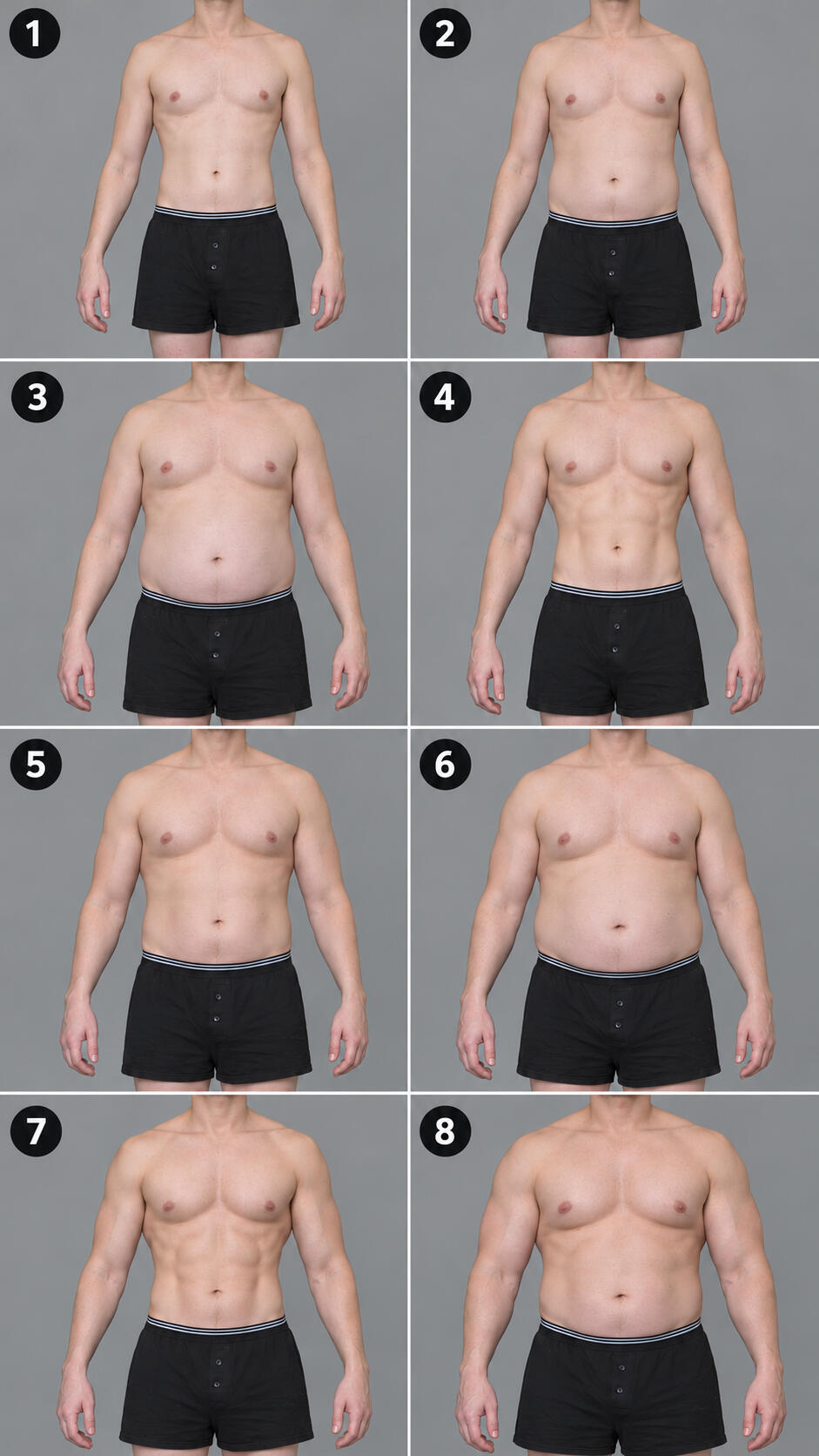
This guide is only a visual reference. It is not a body-fat measurement or diagnosis.